
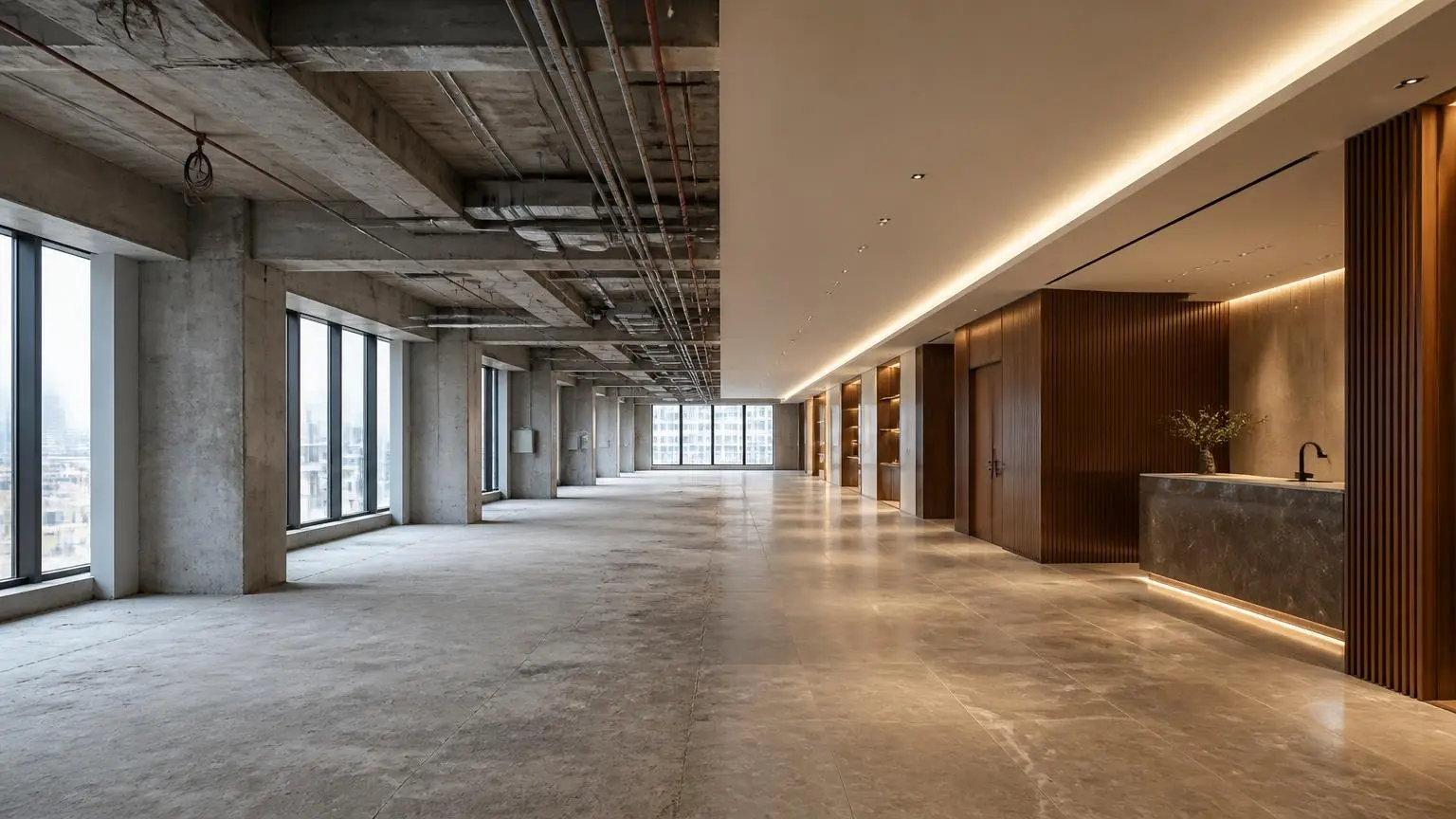
Clients often ask for a fit-out when they mean a renovation, or the reverse. The label matters because it determines what has to be surveyed, what can be reused and where the real risk sits.
Fit-out: building into an empty envelope
A fit-out takes a shell or a stripped space and installs everything that makes it usable: partitions, ceilings, flooring, joinery, lighting and the services that feed them. The envelope is known, the substrate is new and the unknowns are relatively low.
Fit-out risk is concentrated in coordination — services above the ceiling, sequencing between trades and long-lead materials.
Renovation: working against what is already there
A renovation modifies an existing, often occupied, property. Concealed conditions are the defining risk: old waterproofing, undocumented alterations, tired distribution boards, substrates that fail once the finish is removed.
Renovation risk is concentrated in discovery. That is why a proper opening-up survey and a clear variation process are worth more than a lower headline price.
How this changes the numbers
Fit-out pricing can be firm early, because the scope is drawn. Renovation pricing should be firm on the known scope and explicit about what is provisional until opened up. Anyone giving you a fixed price for a renovation without opening anything up is pricing a guess.
- Fit-out: higher material content, tighter coordination, more predictable programme
- Renovation: higher protection and enabling content, more contingency, more inspection
Approvals: the part that decides your start date
Fit-out in a Dubai tower normally runs through the building management and the master developer: a fit-out application, contractor registration, insurance certificates, drawings for approval and a security deposit that is refunded on clean handover. Renovation in a villa community runs through the community management and, where structure, facades or external areas are touched, through the relevant municipality route.
The practical consequence is that a fit-out often cannot start until a deposit is lodged and a permit is issued, while a light villa renovation can begin within days. Budget for the lead time, not just the fee.
- Apartment fit-out in Downtown, Business Bay or JVC: typically 1 to 3 weeks for approval
- Villa renovation in Arabian Ranches, Mudon or Damac Lagoons: 1 to 4 weeks depending on scope
- Anything structural or facade-related: allow longer and design for it early
Which one is your project? A two-minute test
If the space is empty, unfinished or stripped back to shell, you are buying a fit-out and you are paying mostly for new work. If people have lived in it, you are buying a renovation and a real share of your money goes into removal, making good and protecting what stays.
Most Dubai projects are hybrids: a JVT apartment turnaround between tenants is a renovation with fit-out elements; a handed-over shell villa in Damac Lagoons is a fit-out with renovation-grade snag work. Naming it correctly at the quotation stage is what keeps the variations list short.
How this plays out in apartments and villas
In JVC and Dubai Studio City apartments the question is usually fit-out: finishes, joinery and lighting inside an unchanged shell. In Arabian Ranches and Damac Lagoons villas it is more often a renovation, because layouts, MEP routes and external areas are all in play. Naming it correctly at the start decides the approvals, the programme and the price.
Tell us the property and the outcome you want, and we'll tell you honestly which of the two you are dealing with before anyone prices anything.