
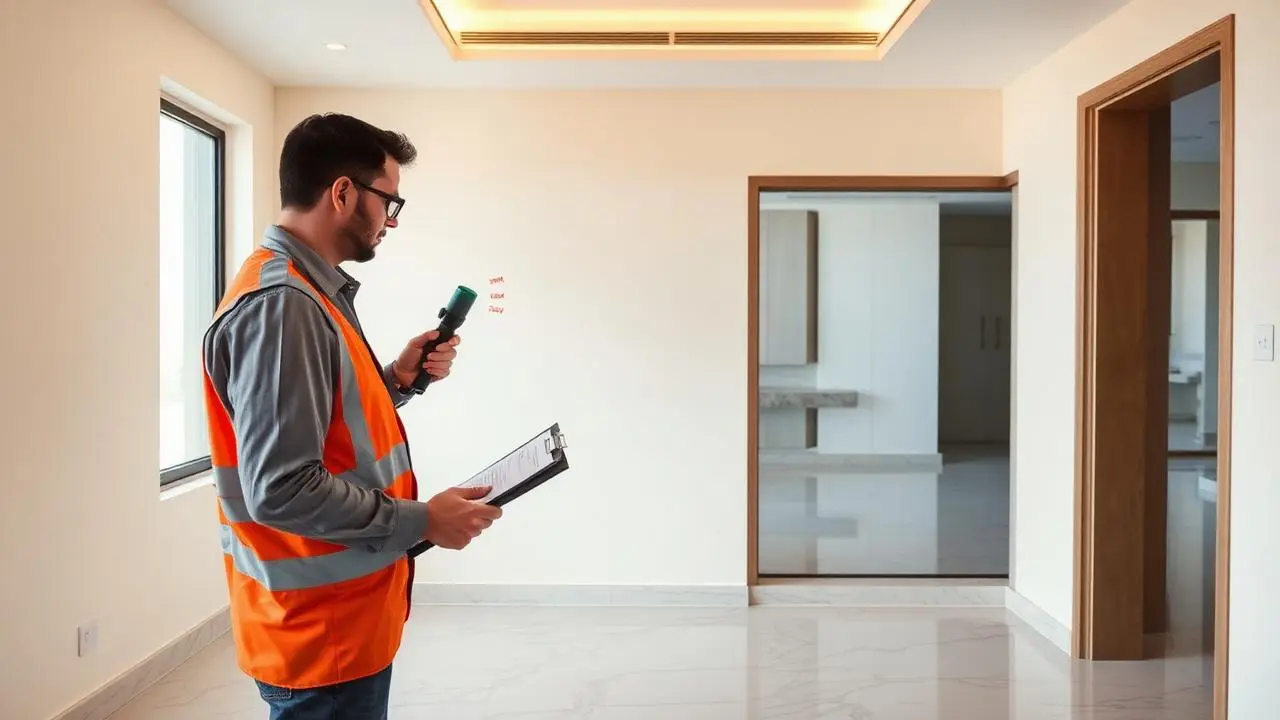
Snagging is the inspection that happens between a developer telling you the property is ready and you accepting that it is. In Dubai it matters more than in most markets: handover volumes are high, finishing trades move fast, and once you've signed the acceptance form the burden of proof quietly moves to you. This guide covers what gets inspected, what it costs, when to book it, and how the Defects Liability Period actually works.
What a snagging inspection actually is
A snagging inspection is an independent, room-by-room examination of a new or newly renovated property against the standard of workmanship you were sold. It's not a valuation and it's not a structural survey. It's a defect list: everything that is incomplete, damaged, badly finished, wrongly installed or not working, written down with photographs and locations so the developer or contractor can fix it.
The output should be a report you can send straight to the developer without editing: numbered items, a photo per item, the room, the trade responsible and a plain description of the fault. A list of vague complaints gets argued about. A numbered evidence pack gets fixed.
When to book it in the handover sequence
The right moment is after the developer says the unit is ready and before you sign the handover or acceptance documents. Most developers in Dubai allow an inspection window on request; ask for it in writing when they invite you to collect keys.
If you've already taken handover, it is still worth doing. The Defects Liability Period gives you a window to raise defects after you move in — a documented list submitted early in that window is far stronger than complaints raised at month eleven.
- Ready-for-handover notice received — request an inspection slot
- Snagging inspection carried out, report issued within 24-48 hours
- Report submitted to the developer, rectification agreed
- De-snag inspection to verify each item was actually closed
- Handover signed once the list is closed or formally accepted with exceptions
What gets checked, and what the expensive faults are
Owners tend to notice paint marks and scratched glass. Those are the cheapest items on any report. The costly defects are the ones a walk-through never reveals, which is exactly why an inspector uses instruments rather than eyes alone.
- AC performance: supply and return temperature split, airflow per outlet, drain pan and condensate line falls, thermostat response
- Water and drainage: pressure at each outlet, trap and waste connections, shower and balcony falls, standing water, silent leaks behind vanities
- Waterproofing: bathroom and balcony thresholds, upstands behind finishes, damp readings on adjoining walls
- Electrical: socket polarity and earthing, RCD trip test, distribution board labelling, loose terminations
- Joinery and doors: alignment, closing gaps, soft-close function, ironmongery, hinge adjustment
- Tiling and stone: hollow tiles tapped through, lippage, grout and silicone lines, damaged edges
- Paint and plaster: undulations under raking light, roller marks, missed corners, filler shrinkage
- Glazing and facade: seals, gaskets, operation of sliding doors, water ingress at frames
How much a snagging inspection costs in Dubai
Pricing is normally driven by covered area and unit type, not by how many defects are found. An apartment is a half-day job; a large villa can take a full day with two inspectors. Expect a fixed fee quoted from the floor area, with the de-snag verification visit either included or priced separately — always ask which.
Set that against what a single missed defect costs. A balcony threshold with no waterproofing usually surfaces as a ruined ceiling below, and by then it is your repair, not the developer's.
The Defects Liability Period, in plain English
New properties in the UAE come with a developer warranty period. In practice there are two layers: a shorter period covering general workmanship and finishes, and a longer one covering major structural elements. The exact durations sit in your sale and purchase agreement — read that document rather than relying on what anyone tells you verbally.
Two things weaken a warranty claim: raising the issue late, and having no evidence of the condition at handover. A snagging report dated before or at handover fixes both problems at once.
Getting the defects actually rectified
Submit the report through the channel named in your handover pack, in writing, with the photographs attached. Ask for a rectification schedule with dates rather than a promise to look into it. Keep every reply.
Then verify. A de-snag visit re-checks each numbered item and marks it closed, partially closed or still open. Rectification work sometimes creates new defects — a repainted wall with a visible patch is not a closed item.
Buying a resale or a handed-over property
Snagging isn't only for off-plan handovers. On a resale, the same inspection tells you what you're inheriting before the transfer: AC nearing the end of its life, waterproofing failures dressed up with fresh paint, unauthorised alterations to the layout or the distribution board. The report becomes a negotiating document as much as a repair list.
Snagging an apartment versus snagging a villa
An apartment handover in Downtown, Business Bay or JVC is dominated by finishing quality and the AC: door alignment, tile lippage, silicone lines, socket positions, water pressure, drainage falls in the shower, and whether every room actually reaches the design temperature. Snag counts of 60 to 150 items on a two-bedroom unit are normal, and that is not a scandal — it is what a first inspection is for.
A villa in Damac Lagoons, Tilal Al Ghaf or Arabian Ranches III adds roof, terrace and external scope: falls to outlets, parapet detailing, external paint coverage, boundary works, landscape drainage and the water tank and pump room. Villa snag lists routinely exceed 200 items, and the expensive ones are almost always water-related.
From snag list to a home that is actually finished
A report is only worth what gets rectified. Send the developer the itemised list with photographs and locations, keep every submission in writing, and book the re-inspection rather than accepting a verbal 'all done'. Anything that reappears goes back on the list with the original reference so the history is visible.
Where the developer refuses an item, or where you have already passed the defects liability period, de-snagging works can be done privately: paint touch-ups, door and ironmongery adjustment, silicone renewal, tile replacement, minor MEP corrections. We do both — the inspection and the rectification — and we are happy to do only the inspection if you would rather keep them separate.
Snagging in new Dubai handovers
Most of our snagging inspections are new handovers in Damac Lagoons, Mudon, JVC and Dubai Studio City. The defects repeat: hollow tiles, doors out of alignment, weak AC airflow, unsealed wet areas and paint finish below spec. We inspect, issue the report your developer needs, and can carry out the rectification ourselves if the developer’s window has closed.
We carry out snagging and de-snagging inspections across Dubai and the wider UAE, and we're happy to be the inspector even when we're not the contractor fixing the list. Send us the unit type and the handover date and we'll tell you what the inspection covers and what it costs.